
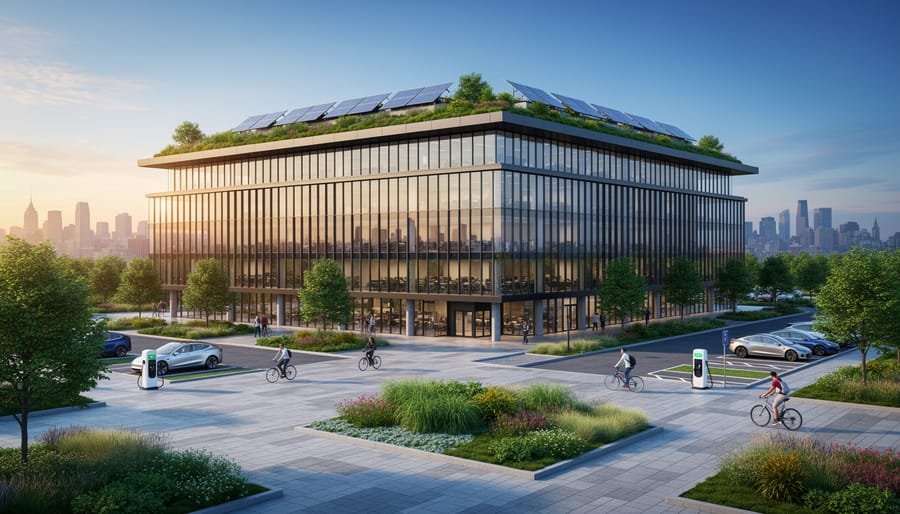
Sustainable design integrates environmental stewardship, resource efficiency, and human well-being into every stage of the built environment lifecycle—from initial concept through construction, operation, and eventual decommissioning. This approach transforms how organizations conceive, develop, and manage facilities by prioritizing reduced carbon emissions, minimized waste generation, enhanced occupant health, and long-term operational cost savings. For ESH professionals and corporate decision-makers, sustainable design represents both an environmental imperative and a strategic business advantage, delivering measurable returns through lower energy consumption, improved regulatory compliance, and strengthened brand reputation.
The business case for sustainable design has evolved dramatically over the past decade. What once appeared as an optional premium has become a competitive necessity as stakeholders demand accountability, investors scrutinize ESG performance, and regulations tighten globally. Organizations implementing sustainable design principles report 20-30% reductions in energy costs, 35% decreases in carbon emissions, and improved employee productivity metrics. Major corporations across manufacturing, healthcare, education, and commercial real estate sectors have documented these benefits through certified projects achieving LEED, BREEAM, and WELL Building Standard recognition.
Understanding sustainable design requires moving beyond superficial “green” aesthetics to grasp its foundational principles: whole-systems thinking, lifecycle assessment, regenerative resource use, and stakeholder engagement. These frameworks guide practitioners in making informed decisions about material selection, energy systems, water management, and indoor environmental quality. For energy managers evaluating facility upgrades, sustainability consultants advising clients, or executives setting corporate environmental targets, comprehensive knowledge of sustainable design methodologies translates directly into implementation success. The following exploration provides the technical clarity, practical frameworks, and real-world examples needed to advance sustainable design initiatives within your organization.
Sustainable design represents a comprehensive methodology that integrates environmental stewardship, economic viability, and social equity throughout the complete lifecycle of products, buildings, and systems. Unlike narrower approaches, sustainable design operates as a holistic framework that addresses interconnected challenges facing organizations today, from climate change mitigation to resource scarcity and stakeholder expectations.
While the terms “sustainable design,” “green building,” and “eco-design” are often used interchangeably, important distinctions exist. Green building primarily focuses on reducing the environmental footprint of constructed facilities through energy efficiency, water conservation, and material selection. Eco-design concentrates specifically on minimizing environmental impacts during product development. Sustainable design, by contrast, encompasses these elements while simultaneously addressing economic feasibility and social considerations including occupant health, community impact, and equitable access to resources.
Understanding core terminology provides clarity for implementation:
The distinguishing characteristic of sustainable design lies in its lifecycle perspective. Rather than optimizing isolated components or single phases, practitioners evaluate cumulative impacts from material sourcing through manufacturing, transportation, installation, operation, maintenance, and eventual decommissioning. This systems-thinking approach often reveals that decisions appearing beneficial in isolation may create unintended consequences elsewhere in the value chain.
For ESH professionals and energy managers, sustainable design provides a structured framework for addressing regulatory requirements while simultaneously identifying operational efficiencies and risk mitigation opportunities. A manufacturing facility designed sustainably, for example, considers not only energy consumption and emissions but also worker safety, community relations, supply chain resilience, and long-term operational costs. This integrated perspective enables organizations to develop solutions that satisfy multiple objectives simultaneously rather than creating tradeoffs between competing priorities.
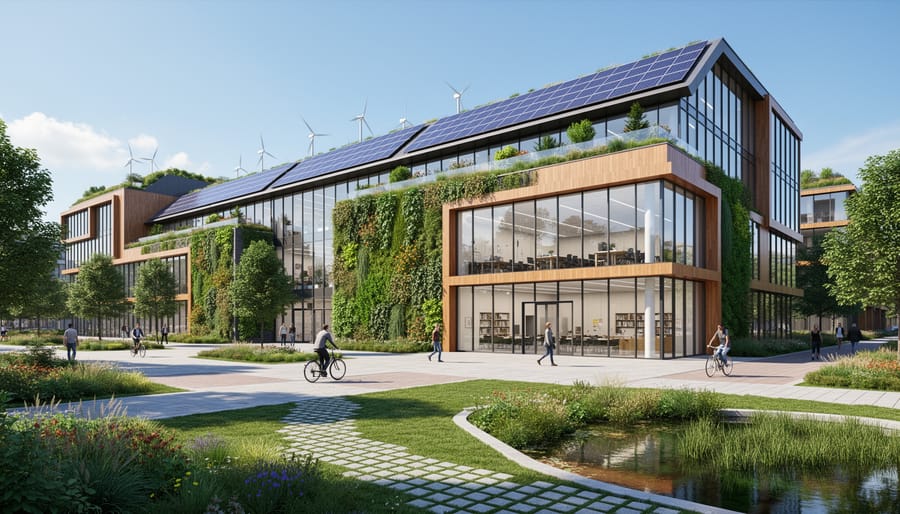
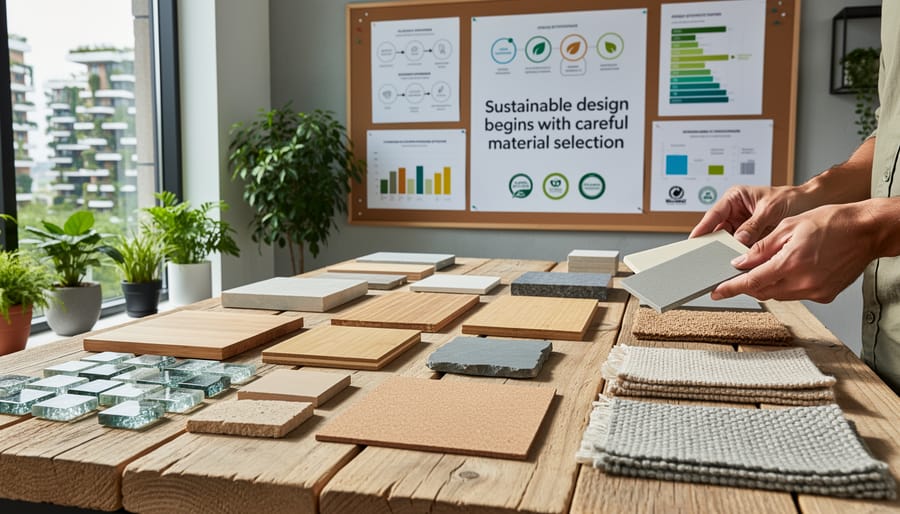
Resource efficiency stands at the core of sustainable design, transforming how organizations approach material consumption, energy use, and waste generation. This principle recognizes that every resource extracted, processed, and utilized carries environmental, economic, and social implications that extend throughout the product lifecycle. By strategically minimizing resource inputs while maximizing functional outputs, sustainable design creates value propositions that align environmental stewardship with operational excellence.
Material selection represents the first critical decision point in resource conservation. Sustainable designers prioritize materials based on multiple criteria: renewable content, recycled composition, local sourcing to reduce transportation impacts, durability to extend service life, and end-of-life recyclability or biodegradability. Industry leaders increasingly employ life cycle assessment tools to quantify embodied energy and environmental footprints across material alternatives. For instance, specifying aluminum with high recycled content can reduce embodied energy by up to 95 percent compared to virgin material, demonstrating how informed material choices deliver measurable efficiency gains.
Energy optimization strategies complement material decisions by addressing operational resource consumption throughout a facility’s or product’s lifespan. Key approaches include:
These strategies collectively address both design-phase specifications and operational protocols, ensuring comprehensive resource stewardship. Corporate sustainability leaders report that integrating these efficiency measures during initial design phases typically costs 15-20 percent less than retrofitting existing infrastructure while delivering superior performance outcomes.
Waste reduction strategies complete the resource efficiency framework by addressing material flows throughout construction, operation, and decommissioning phases. Progressive organizations implement circular economy principles, designing for disassembly and material recovery from project inception. This approach transforms traditional linear consumption models into regenerative systems where waste from one process becomes feedstock for another, fundamentally redefining resource relationships.
Sustainable design fundamentally requires systems thinking—an analytical approach that recognizes buildings, products, and processes as interconnected components within larger environmental, social, and economic systems. Rather than optimizing individual elements in isolation, this methodology examines how design decisions ripple through multiple systems simultaneously, creating cascading effects that can either amplify benefits or generate unintended consequences.
In practice, systems thinking demands that professionals evaluate the relationships between building mechanical systems, energy sources, water cycles, material flows, occupant behavior, and surrounding ecosystems. For example, specifying high-efficiency HVAC equipment delivers limited value if the building envelope remains poorly insulated, or if the energy source relies entirely on fossil fuels. A systems perspective identifies these interdependencies, enabling integrated solutions that address root causes rather than symptoms.
Consider a corporate campus development: traditional approaches might separately optimize landscaping, stormwater management, and cooling systems. Systems thinking reveals the integration opportunity—native vegetation reduces irrigation demands while providing shade that decreases cooling loads, and bioswales manage stormwater while supporting local biodiversity. This integrated approach typically delivers 20-30% greater resource efficiency than siloed optimization.
Leading organizations now employ cross-functional teams during design phases, bringing together energy managers, environmental specialists, operations personnel, and financial analysts. This collaborative structure ensures that system interactions receive proper consideration from project inception. Recent case studies from manufacturing facilities demonstrate that integrated design processes reduce long-term operational costs by 15-40% compared to conventional approaches, while simultaneously improving environmental performance metrics.
The transition to systems thinking requires investment in analytical tools, training, and organizational culture shifts, yet the resulting optimization potential justifies these upfront commitments for organizations committed to meaningful sustainability outcomes.
Sustainable design requires a comprehensive lifecycle perspective that evaluates environmental, social, and economic impacts from raw material extraction through manufacturing, transportation, use, and end-of-life disposal or recovery. This cradle-to-grave—or preferably cradle-to-cradle—analysis reveals hidden impacts that might otherwise remain invisible when focusing solely on a product’s operational phase.
Lifecycle assessment (LCA) serves as the primary methodology for quantifying these impacts across categories including carbon emissions, water consumption, resource depletion, and toxicity. For ESH professionals, LCA data provides the empirical foundation for identifying improvement opportunities and substantiating sustainability claims to stakeholders and regulatory bodies.
The circular economy framework builds upon lifecycle thinking by fundamentally redesigning systems to eliminate waste. Rather than the traditional linear model of take-make-dispose, circular design keeps materials and products in continuous use through strategies including designing for durability, modularity, repairability, refurbishment, remanufacturing, and eventual recycling. This approach decouples economic growth from virgin resource consumption while creating new business opportunities in service-based models and reverse logistics.
Implementation requires collaboration across value chains. Leading manufacturers now design products with disassembly instructions, standardized components, and material passports that document composition for future recovery. The Ellen MacArthur Foundation reports that circular economy principles could generate $4.5 trillion in economic benefits by 2030 while significantly reducing environmental impacts.
For energy managers and sustainability consultants, circular strategies translate into measurable outcomes: reduced procurement costs through remanufacturing, decreased waste disposal fees, enhanced brand reputation, and improved regulatory compliance. Organizations like Interface and Philips demonstrate how circular business models create competitive advantage while advancing environmental objectives, proving that lifecycle thinking and circularity represent essential components of comprehensive sustainable design strategies.
In the built environment, sustainable design represents a fundamental shift from conventional construction practices toward holistic approaches that minimize environmental impact while maximizing occupant wellbeing and operational efficiency. This transformation addresses the fact that buildings account for approximately 40% of global energy consumption and nearly one-third of greenhouse gas emissions.
Passive design strategies form the foundation of sustainable architecture, leveraging natural systems to reduce mechanical heating, cooling, and lighting demands. These techniques include optimal building orientation to maximize solar gain in winter while minimizing summer heat, strategic window placement for cross-ventilation and daylighting, thermal mass integration to moderate temperature fluctuations, and high-performance building envelopes that minimize heat transfer. When properly implemented, passive strategies can reduce energy consumption by 30-50% compared to conventional designs.
Renewable energy integration has become standard practice in high-performance buildings. Photovoltaic systems, geothermal heat pumps, and solar thermal collectors now complement passive strategies to achieve net-zero or net-positive energy performance. The Edge building in Amsterdam exemplifies this integration, generating more energy than it consumes while achieving a 98.4% BREEAM sustainability score.
Material selection critically influences environmental outcomes throughout a building’s lifecycle. Sustainable practices prioritize recycled content, rapidly renewable materials, low-embodied carbon alternatives, and products manufactured using responsible practices. Life cycle assessment tools enable quantitative comparison of material impacts from extraction through disposal.
Occupant health considerations have gained prominence following research linking indoor environmental quality to productivity and wellbeing. Sustainable buildings emphasize superior indoor air quality through low-VOC materials, enhanced ventilation systems, and pollutant source control, alongside access to natural light and views, thermal comfort optimization, and acoustic performance standards that support concentration and collaboration.
Sustainable design principles transform energy systems through strategic integration of renewable generation, intelligent distribution infrastructure, and advanced management platforms. The sector’s decarbonization imperative drives adoption of hybrid systems combining solar, wind, and storage technologies while optimizing existing grid infrastructure for enhanced efficiency and reliability.
Modern power generation facilities increasingly employ lifecycle assessment methodologies during planning phases, evaluating environmental impacts from construction through decommissioning. Progressive utilities implement distributed energy resource management systems that balance intermittent renewables with demand response programs, reducing peak load stress and transmission losses by 15-30% in documented applications.
Distribution network modernization focuses on grid resilience and flexibility. Smart metering infrastructure enables real-time consumption monitoring, while automated switching systems minimize outage duration and facilitate microgrid integration. Energy management systems deployed across commercial and industrial facilities deliver measurable results—manufacturing operations report 20-35% energy intensity reductions through equipment optimization and process scheduling aligned with renewable availability.
Case studies from European utilities demonstrate how digital twins and predictive analytics enhance asset performance while extending infrastructure lifespan. These implementations reduce maintenance costs while supporting ambitious carbon reduction targets. Organizations pursuing comprehensive energy transformation increasingly recognize that technology deployment must align with robust governance frameworks, stakeholder engagement strategies, and workforce capability development to achieve sustained performance improvements and regulatory compliance.
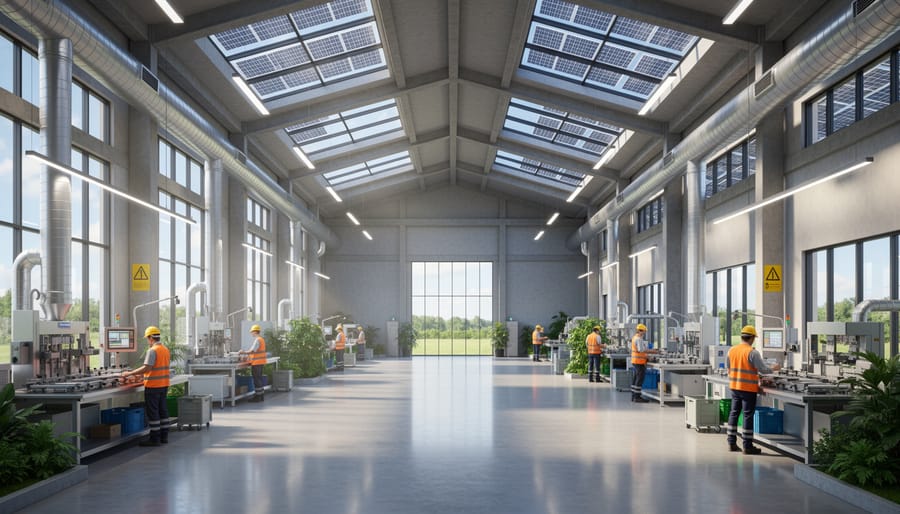
In industrial and manufacturing contexts, sustainable design transforms production systems through comprehensive material selection, waste reduction, and energy optimization strategies. Modern manufacturing facilities integrate circular economy principles by designing products for disassembly, remanufacturing, and material recovery at end-of-life. This approach minimizes virgin resource consumption while creating secondary revenue streams from reclaimed materials.
Supply chain sustainability requires mapping environmental impacts across procurement, logistics, and distribution networks. Leading manufacturers now evaluate suppliers based on carbon footprint, water usage, and waste management practices, establishing performance criteria that cascade sustainability requirements throughout the value chain. Digital technologies including IoT sensors and artificial intelligence enable real-time monitoring of resource consumption, identifying optimization opportunities that reduce both environmental impact and operational costs.
Operational excellence in sustainable manufacturing demands integration of ESH implementation strategies that align environmental performance with worker safety and health outcomes. Toyota’s lean manufacturing philosophy demonstrates this integration, where waste elimination simultaneously improves efficiency and reduces hazardous material exposure.
Case in point: Interface, Inc. transformed its carpet manufacturing operations by implementing closed-loop recycling systems, reducing greenhouse gas emissions by 96% since 1996 while maintaining profitability. This exemplifies how systematic sustainable design in industrial processes delivers measurable ESH compliance improvements alongside business value creation.
Sustainable design implementation relies on structured frameworks and standardized assessment tools that provide measurable benchmarks and third-party validation. These internationally recognized systems enable organizations to evaluate environmental performance, demonstrate compliance, and communicate sustainability achievements to stakeholders with credibility and consistency.
The most widely adopted certification systems offer comprehensive approaches to evaluating sustainability across building lifecycles and organizational operations. Understanding the distinctions between these frameworks allows professionals to select appropriate tools aligned with specific project requirements and organizational objectives.
| Framework | Primary Focus | Application Sector | Key Metrics |
|---|---|---|---|
| LEED (Leadership in Energy and Environmental Design) | Whole-building environmental performance | Commercial, residential, institutional buildings | Energy use, water efficiency, materials selection, indoor environmental quality |
| BREEAM (Building Research Establishment Environmental Assessment Method) | Building sustainability assessment | New construction, refurbishment, communities | Energy, health, materials, waste, ecology, pollution |
| WELL Building Standard | Human health and wellness | Buildings and interiors | Air quality, water quality, nourishment, lighting, fitness, comfort |
| ISO 14000 Series | Environmental management systems | All industries and organizations | Environmental policy, planning, implementation, monitoring, review |
| Living Building Challenge | Regenerative design performance | Buildings, infrastructure, neighborhoods | Net-positive energy, water, waste; materials transparency; equity |
Each framework serves distinct purposes within the sustainability ecosystem. LEED, developed by the U.S. Green Building Council, remains the dominant certification system globally with over 100,000 projects across 185 countries. Its point-based rating system provides flexibility while maintaining rigorous performance standards across categories including sustainable sites, water efficiency, and innovation in design.
BREEAM, originating in the United Kingdom in 1990, represents the longest-established assessment method and maintains particular strength in European markets. Its scientific basis and regular updates ensure alignment with evolving environmental priorities and regulatory requirements.
The ISO 14000 series offers broader organizational application beyond individual buildings, establishing environmental management system frameworks applicable across manufacturing, services, and public sector entities. ISO 14001 certification demonstrates systematic approaches to identifying environmental aspects, setting objectives, and driving continuous improvement through plan-do-check-act cycles.
Emerging frameworks address specialized concerns within sustainable design. The WELL Building Standard prioritizes occupant health outcomes, reflecting growing recognition of connections between built environments and human wellbeing. This focus resonates particularly with corporate real estate decision-makers managing workforce productivity and talent retention.
Regional and sector-specific standards complement these global frameworks. Green Star operates across Australia and New Zealand, while the Living Building Challenge sets aspirational regenerative design targets requiring net-positive resource performance. Industry-specific standards address unique requirements in healthcare, education, and data center environments.
Implementation requires understanding assessment methodologies, documentation requirements, and verification processes specific to each framework. Organizations frequently pursue multiple certifications simultaneously to address diverse stakeholder expectations and market requirements. Strategic framework selection considers project goals, geographic markets, stakeholder priorities, budget constraints, and internal capacity for ongoing compliance and reporting obligations.
Sustainable design delivers measurable competitive advantages that extend well beyond environmental compliance. Organizations implementing sustainable design principles consistently demonstrate superior financial performance, enhanced risk management, and stronger stakeholder relationships—outcomes that directly impact long-term viability.
The financial case for sustainable design rests on both cost reduction and value creation. Energy-efficient buildings reduce operational expenses by 25-40% compared to conventional designs, according to data from the U.S. Green Building Council. Material optimization and circular design principles minimize waste disposal costs while creating new revenue streams through material recovery and product-as-service models. A 2023 McKinsey analysis found that companies integrating sustainable design across operations achieved 15-30% higher EBITDA margins within three years of implementation.
Risk mitigation represents another critical value driver. Sustainable design reduces exposure to volatile energy prices, supply chain disruptions, and regulatory penalties. Organizations that proactively adopt sustainable practices avoid costly retrofits and operational disruptions when regulations tighten. The European Union’s Corporate Sustainability Reporting Directive and similar frameworks worldwide make sustainability performance increasingly material to financial reporting, directly affecting access to capital and investor confidence.
Regulatory compliance is transitioning from checkbox exercise to strategic necessity. Building codes increasingly mandate energy performance standards, material disclosure, and lifecycle assessments. The International Energy Conservation Code updates reflect this trend, with each revision raising baseline requirements. Forward-thinking organizations view these requirements not as burdens but as frameworks for achieving operational ESH excellence that differentiates them competitively.
Stakeholder expectations now demand sustainable design as table stakes. Investors increasingly apply ESG criteria to allocation decisions, with sustainable funds managing over $2.7 trillion in assets as of 2024. Employees, particularly younger professionals, prioritize working for environmentally responsible organizations. The Harvard Business Review reports that 70% of employees consider sustainability when choosing employers, affecting talent acquisition and retention.
Customer preferences similarly favor sustainable products and services. B2B procurement increasingly requires verified sustainability credentials, while consumer research shows willingness to pay premiums for demonstrably sustainable offerings. This creates market opportunities for organizations embedding sustainability into design processes.
The cumulative effect positions sustainable design not as an optional initiative but as fundamental to business strategy, driving profitability while building organizational resilience against emerging environmental and regulatory challenges.
Organizations implementing sustainable design frequently encounter resistance related to perceived cost premiums and disruption to established workflows. Industry data reveals that initial sustainable material specifications can increase project budgets by 2-8% depending on sector and scope. However, this challenge often stems from narrow cost-benefit analysis that fails to account for lifecycle value. Leading organizations address this barrier by establishing total cost of ownership frameworks that quantify energy savings, maintenance reduction, waste disposal avoidance, and productivity gains over a 10-15 year horizon. Manufacturing facilities that adopted sustainable design principles documented 15-25% reductions in operational costs within three years, effectively offsetting initial investments.
Another significant obstacle involves gaps in technical expertise and capacity. Many sustainability managers inherit responsibility for sustainable design implementation without specialized training in circular economy principles, green building systems, or lifecycle assessment methodologies. This knowledge deficit creates implementation delays and suboptimal outcomes. Forward-thinking organizations are investing in targeted professional development programs and leveraging ESH consultancy support to bridge capability gaps during critical phases. Cross-functional collaboration between sustainability teams, procurement, design, and operations departments accelerates knowledge transfer and embeds sustainable thinking throughout project lifecycles.
Supply chain limitations present practical challenges, particularly for organizations operating in regions with limited access to certified sustainable materials or specialized contractors. A global automotive manufacturer documented 18-month delays in sustainable facility upgrades due to regional availability constraints for reclaimed materials and low-VOC finishes. Successful resolution strategies include expanding supplier networks proactively, establishing preferred vendor partnerships with sustainability criteria, and allowing extended procurement timelines in project planning phases.
Organizations that achieve sustainable design implementation success typically establish clear governance structures with defined accountability. This includes sustainability performance metrics integrated into departmental KPIs, regular progress reviews with senior leadership, and dedicated budget allocations rather than project-by-project approvals. A multinational retail chain reduced implementation cycle times by 40% after establishing a centralized sustainable design review board with cross-functional representation and decision-making authority. Starting with pilot projects in controlled environments allows teams to develop expertise, refine processes, and document results that build internal credibility for broader rollout.
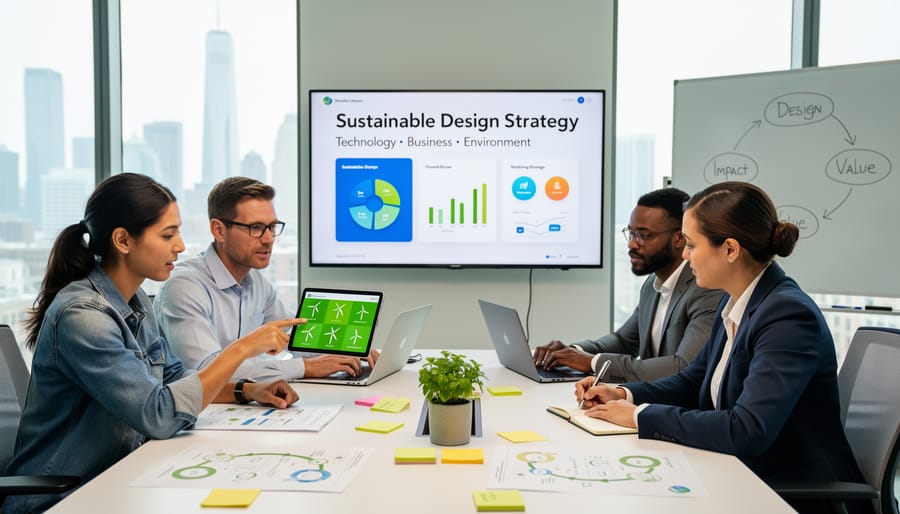
The following case studies illustrate how sustainable design principles translate into measurable environmental and financial performance across different facility types.
Corporate Headquarters Retrofit: Unilever’s Singapore Manufacturing Site
Unilever’s Singapore campus demonstrates the retrofit potential of sustainable design at existing industrial facilities. Completed in 2015, the project transformed a conventional manufacturing operation into a net-zero waste site while reducing energy consumption by 35% and water usage by 42% compared to baseline measurements.
The design team implemented integrated solutions including daylight harvesting systems that reduced artificial lighting demand, high-efficiency HVAC units with variable speed drives, and a rainwater capture system processing 25,000 cubic meters annually. Manufacturing process water underwent treatment enabling 90% reuse in cooling systems. Solar thermal arrays provided 15% of the facility’s thermal energy requirements.
Beyond environmental metrics, the retrofit achieved 18-month payback on energy efficiency measures through reduced utility costs totaling $1.2 million annually. Waste diversion reached 99.8%, with material recovery generating $380,000 in annual revenue. Employee satisfaction surveys indicated 23% improvement in workplace comfort ratings, correlating with reduced absenteeism.
The primary lesson learned centered on early cross-functional collaboration. Engaging operations staff, maintenance teams, and production managers during design phases prevented conflicts between sustainability goals and operational requirements. This approach proved essential for building operational value rather than implementing theoretical solutions incompatible with manufacturing realities.
New Industrial Development: Volkswagen’s Chattanooga Assembly Plant
Volkswagen’s Tennessee facility exemplifies sustainable design integration in new construction. Opened in 2011, the LEED Platinum-certified plant became the first automotive manufacturing facility globally to achieve this recognition.
Design strategies included a 9.5-acre green roof providing stormwater management for 90% of site runoff, reducing municipal infrastructure burden. Advanced paint shop technologies decreased volatile organic compound emissions by 20% below industry standards while cutting water consumption by 30% per vehicle. Natural ventilation systems eliminated mechanical cooling for 75% of assembly areas, supported by computational fluid dynamics modeling during design phases.
Operational results validated the business case: energy costs averaged 25% below comparable facilities, totaling $8 million in annual savings. Water reclamation systems reduced municipal water demand by 40%, generating $400,000 yearly savings. The site diverts 95% of manufacturing waste from landfills, creating revenue streams exceeding $2 million annually.
Critical success factors included establishing performance metrics before construction commenced and implementing real-time monitoring systems enabling continuous optimization. Integration with local ecosystems, including wetland restoration buffering the site, delivered regulatory advantages while supporting biodiversity objectives.
These cases confirm that sustainable design delivers quantifiable returns when aligned with operational priorities and supported by measurement systems tracking both environmental and financial performance.
Sustainable design has evolved from a progressive ideal to an essential competency for professionals navigating today’s environmental, safety, and health landscape. Organizations can no longer treat sustainability as a peripheral consideration—regulatory frameworks, stakeholder expectations, and competitive pressures have elevated it to a fundamental business requirement. For ESH professionals, energy managers, and sustainability consultants, mastering sustainable design principles represents not just career advancement but professional necessity.
The integration of sustainable design into ESH practice implementation delivers measurable results: reduced operational costs, enhanced regulatory compliance, improved employee health and safety outcomes, and strengthened corporate reputation. Organizations that embed these principles systematically into their operations consistently outperform peers in both financial and environmental metrics.
The path forward requires honest assessment of current practices. Examine your organization’s design processes, procurement decisions, and operational protocols. Identify gaps between stated sustainability commitments and actual implementation. Where do opportunities exist for material efficiency improvements, energy optimization, or circular economy integration?
Alliance Safety Council offers comprehensive support for this transition, providing expertise in sustainable design frameworks, implementation strategies, and performance measurement. Our collaborative approach ensures that sustainability initiatives align with operational realities while delivering genuine environmental and business value.
The question is no longer whether to embrace sustainable design, but how quickly your organization can integrate these essential principles into standard practice. The competitive advantage belongs to those who act decisively.